Can sunlight be used to power Nuclear Fusion Reactors? Let's check it out!
To begin with, there are several prototypes of Fusion Reactors. Today we will be focusing upon Laser Inertial Fusion. It uses laser light in the Ultraviolet spectrum at a wavelength of 351 nanometers to bombard a pellet of condensed Hydrogen atoms from all sides, igniting the fuel and creating energy in the process.
So where does sunlight enter the equation? Well, sunlight reaches the earth as a dirty, jumbled mix of different wavelengths, of which Ultraviolet light is one component. That is why scientists recommend wearing sunscreen, because Ultraviolet light is particularly carcinogenic to human skin.
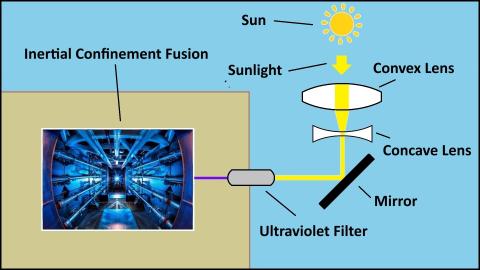
But what if the Ultraviolet light could be harnessed, and used for the purposes of pulsed laser fusion? First the sunlight would be concentrated via both a concave and a convex lens, narrowing it to the width of a pinprick. Then it would be bounced off of a mirror, and directed towards the fusion reactor.
At some point it would pass through a filter, which would remove the unwanted wavelengths, leaving only 351-nanometer Ultraviolet light. From there it would be fed into the reactor chamber, striking the hydrogen pellet.
Multiple this device many dozens of times over, bombarding the Hydrogen from all sides, and theoretically the conditions for fusion ignition would be satisfied.
Of course, this is about as preliminary as a blueprint can get. It probably is nowhere near that simple. But it certainly is a start. From here, Physicists can refine and improve the process, possibly leading to a future of Solar Laser Fusion power generation.
Add new comment